

Hello everyone! My name is Franco and I’m from Argentina. I’m opening this thread to document the design and construction from-scratch of my embossing lathe recorder. I’ll be sharing my progress here.
any advice is more than welcome—since I’m new to this, all I’ve done so far is based on information I’ve gathered from various forums. If you’ve built your own recorder, I’d love to hear your suggestions for improvements or corrections to the machine.
My DIY Lathe recorder from scratch
Moderators: piaptk, tragwag, Steve E., Aussie0zborn
Re: My DIY Lathe recorder from scratch
this is the machine and it´s control board, its just an start stop, left right, and a pot to control the speed of the steeper motor that moves the head
You do not have the required permissions to view the files attached to this post.
Re: My DIY Lathe recorder from scratch
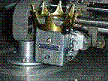
This is the head—this is where I need every bit of advice and assistance I can get. I’ve managed to make a few recordings, but they suffer from low volume and poor sound clarity. Everything is 3D-printed, and I’m using vibration speakers.
You do not have the required permissions to view the files attached to this post.
Re: My DIY Lathe recorder from scratch
I placed a hollow cylinder filled with small lead balls in the counterweight, since the head is quite heavy due to the speakers.
Re: My DIY Lathe recorder from scratch
This is an earlier version of the head. I managed to get it working, but the results weren’t great, and the torque tube was damaging my needle. I'm currently using a commercial sapphire stylus. I also have a homemade stylus made from a tungsten carbide electrode.
You do not have the required permissions to view the files attached to this post.
Re: My DIY Lathe recorder from scratch
Here you can see it recording—or rather destroying—an acrylic disc, haha. I also included a picture of a commercial vinyl record to compare the difference in groove quality.
You do not have the required permissions to view the files attached to this post.
Re: My DIY Lathe recorder from scratch
This is the amplifier I’m using, and for the audio source, I’m using my PC with Audacity. All I do is take a sample song, apply the ‘RIAA’ curve and then invert it. I’m not sure if that’s the correct approach.
You do not have the required permissions to view the files attached to this post.
Re: My DIY Lathe recorder from scratch
So far, this is everything I’ve got. I would truly appreciate any help you can offer. My goal is to eventually open a local service in my city to cut records for small bands that can’t afford a big-budget recording.
Re: My DIY Lathe recorder from scratch
Hi diy_cutter,I really appreciate the work you do. I follow you on Instagram and wanted to know your opinion about my machine and if you could give me any advice.
-
Fela Borbone
- Posts: 306
- Joined: Thu Mar 07, 2013 5:22 pm
- Location: Valencia, Spain
Re: My DIY Lathe recorder from scratch
Hola Franco,
You cutter looks good, but keep the moving mass (inside the cutter head)as low as possible, every fraction of a gram counts, thats the trade-off, low mass but as stiff as possible.
Also,instead of acrilic, try policarbonate or petg, they are more easy.
Keep the good work!
You cutter looks good, but keep the moving mass (inside the cutter head)as low as possible, every fraction of a gram counts, thats the trade-off, low mass but as stiff as possible.
Also,instead of acrilic, try policarbonate or petg, they are more easy.
Keep the good work!
Re: My DIY Lathe recorder from scratch
Fela Borbone wrote: ↑Sat May 17, 2025 4:36 ambut keep the moving mass (inside the cutter head)
Hi! Thank you so much for your advice, although I really didn’t fully understand what you meant— which mass should I reduce?
-
Fela Borbone
- Posts: 306
- Joined: Thu Mar 07, 2013 5:22 pm
- Location: Valencia, Spain
Re: My DIY Lathe recorder from scratch
I mean the mass that the speakers move,
The parts linking the coil to the stylus, It takes lots of energy to move fast enough big mass.
The parts linking the coil to the stylus, It takes lots of energy to move fast enough big mass.
-
spinnertownblanks

- Posts: 227
- Joined: Wed Jan 17, 2024 2:00 pm
Re: My DIY Lathe recorder from scratch
You definitely want to work with the right materials to know what’s happening. As Fela Borbone mentioned, If embossing use Polycarbonate and if cutting use PETG. Then you can see where you are at sound wise and go from there.
Blank recordable discs, diamonds and accessories for the lathe cutting world, based in the UK.
www.spinnertownblanks.com
www.instagram.com/spinnertownblanks
www.facebook.com/spinnertownblanks
www.spinnertownblanks.com
www.instagram.com/spinnertownblanks
www.facebook.com/spinnertownblanks
-
themagician

- Posts: 26
- Joined: Tue Dec 12, 2023 4:33 pm
Re: My DIY Lathe recorder from scratch
Hey firstly, nice build. 3D printed parts can be a bit different to work with but keep going!
Some have already offered sound advice regarding embossing onto Polycarbonate or PETG instead of acrylic, and the reduction of mass is critical on the moving parts of the cutterhead.
The V-String torque tube coupling I see on your later images would be the design I would continue developing, I suggest increasing the spacer distance a tad from the back of the cutter head to the V-String itself.
You could also try printing the speaker cones as just that - cones with a small cylinder cut out from the core to place your metal rods on inside of the core, this will avoid the weight of the screws on the side of the cones (see attached image).
For the tuning side, I recommend having a morning coffee and a deep dive into Spinner Town Blanks excellent blog on the matter:
https://spinnertownblanks.com/blogs/spinner-town-blog/how-to-map-and-eq-your-dynamic-cutterhead
Then after you have your EQ curve(s), you can then use them to process audio that is prepared for your cutter head specifically.
Don't worry about iRIAA/RIAA etc, that all gets sorted out during the EQ mapping. I've heard of others applying a curve prior to the EQ but that doesn't make sense to me to do so in the digital space.
If you get stuck, just reach out.
Ronnied The Magician
Some have already offered sound advice regarding embossing onto Polycarbonate or PETG instead of acrylic, and the reduction of mass is critical on the moving parts of the cutterhead.
The V-String torque tube coupling I see on your later images would be the design I would continue developing, I suggest increasing the spacer distance a tad from the back of the cutter head to the V-String itself.
You could also try printing the speaker cones as just that - cones with a small cylinder cut out from the core to place your metal rods on inside of the core, this will avoid the weight of the screws on the side of the cones (see attached image).
Your tuning workflow and then audio processing workflow needs some structure in order to achieve the best results.This is the amplifier I’m using, and for the audio source, I’m using my PC with Audacity. All I do is take a sample song, apply the ‘RIAA’ curve and then invert it. I’m not sure if that’s the correct approach.
For the tuning side, I recommend having a morning coffee and a deep dive into Spinner Town Blanks excellent blog on the matter:
https://spinnertownblanks.com/blogs/spinner-town-blog/how-to-map-and-eq-your-dynamic-cutterhead
Then after you have your EQ curve(s), you can then use them to process audio that is prepared for your cutter head specifically.
Don't worry about iRIAA/RIAA etc, that all gets sorted out during the EQ mapping. I've heard of others applying a curve prior to the EQ but that doesn't make sense to me to do so in the digital space.
If you get stuck, just reach out.
Ronnied The Magician
You do not have the required permissions to view the files attached to this post.
Re: My DIY Lathe recorder from scratch
themagician wrote: ↑Wed Jun 04, 2025 5:25 amHey firstly, nice build. 3D printed parts can be a bit different to work with but keep going!...
Hi Magician!
First of all, apologies for not replying earlier — I haven’t used the forum in quite a while. I took note of your feedback and spent some time working on the design of the embossing cutterhead, but I’ve run into a few issues with the V-spring, mainly related to its stiffness.
I’m leaving a link to a video where I explain the problem.
Please forgive my English — it’s not my native language!
V-SPRING VIDEO:
https://youtu.be/bnXgNWXhENs?si=bWvIPH4xqGZVvAph
-
themagician
- Posts: 26
- Joined: Tue Dec 12, 2023 4:33 pm
Re: My DIY Lathe recorder from scratch
Hi fanelx,
Thanks for sharing your video, it was useful to understand what you have now and what your ideas are regarding your v3 cutter head.
As you already mentioned, the V-Spring is waaaaaay too loose, and it will do very little in supporting the torque tube and controlling it's motions adequately.
I initially experimented with metal v-springs but ended up printing this piece (for future consistency mainly) - see attached images.
Using Claude, I've asked it for the young-modulus equivalent of this piece, recreated using metal and it's conclusions are also attached.
Summary is, it seems to be about 1mm of metal thickness is approximately the same as my 3.85mm PLA piece.
Have you considered printing this piece and inserting a metal rod in the middle?
As for the piano-wire cantilever section, I've got mixed feeling about this as some cutter head designs of mine omit this altogether and sound absolutely fine so I'm leaning towards removing it altogether from any future designs.
Lastly your main metal push rods from the driver to the torque tube.... argghhhh... why introduce non-linear errors here by offsetting these (soldering two pieces instead of using just the one)? I strongly recommend you use a single concentric rod to push against your torque tube and don't use a metal screw to affix it on the side. This will again introduce asymmetry and additional weight on your critical moving parts.
Good luck and please keep the forum updated on your progress!
Ronnie D
Thanks for sharing your video, it was useful to understand what you have now and what your ideas are regarding your v3 cutter head.
As you already mentioned, the V-Spring is waaaaaay too loose, and it will do very little in supporting the torque tube and controlling it's motions adequately.
I initially experimented with metal v-springs but ended up printing this piece (for future consistency mainly) - see attached images.
Using Claude, I've asked it for the young-modulus equivalent of this piece, recreated using metal and it's conclusions are also attached.
Summary is, it seems to be about 1mm of metal thickness is approximately the same as my 3.85mm PLA piece.
Have you considered printing this piece and inserting a metal rod in the middle?
As for the piano-wire cantilever section, I've got mixed feeling about this as some cutter head designs of mine omit this altogether and sound absolutely fine so I'm leaning towards removing it altogether from any future designs.
Lastly your main metal push rods from the driver to the torque tube.... argghhhh... why introduce non-linear errors here by offsetting these (soldering two pieces instead of using just the one)? I strongly recommend you use a single concentric rod to push against your torque tube and don't use a metal screw to affix it on the side. This will again introduce asymmetry and additional weight on your critical moving parts.
Good luck and please keep the forum updated on your progress!
Ronnie D
You do not have the required permissions to view the files attached to this post.

Re: My DIY Lathe recorder from scratch
Hello!
As a side note, I'd like to tell you that these Class D amplifiers don't handle high frequencies well [those above 12 kHz],
so it would be better if you found a cheap Technics amplifier, such as the SU-V300. Even the cheapest Technics and the cheapest ones on the market have power amplifiers that will certainly handle frequencies above 12 kHz, as that's what you'll need most. Remember to put 0.2-0.5 amp fuses in series to avoid burning out the amplifier.
If you want to push high frequencies, I suggest using cheap car tweeters. I made my first heads using BMW car tweeters, they reached a 15kHz band with a drop of about -20dB for this frequency, but it needs to be 0dB at 15kHz [i.e. almost 100% efficiency], as is the case with heads costing at least $15k and this is the critical limit, i.e. the price works wonders.

Re: My DIY Lathe recorder from scratch
I'd like to point out something crucial: you said you simply used the RIA curve in Audacity, but it's really not suitable, not at all. You absolutely must go through the mapping stage of your cutting head; it's truly essential for making progress! Sincerely, Sébastien
Re: My DIY Lathe recorder from scratch
Hi! thanks for this! so how can i do it? what program shoud i use?Semar wrote: ↑Tue Dec 16, 2025 6:52 amI'd like to point out something crucial: you said you simply used the RIA curve in Audacity, but it's really not suitable, not at all. You absolutely must go through the mapping stage of your cutting head; it's truly essential for making progress! Sincerely, Sébastien
-
displacedsnail

- Posts: 130
- Joined: Sat Aug 12, 2023 8:34 am
- Location: Philadelphia, PA
- Contact:
Re: My DIY Lathe recorder from scratch
Spinner Town has a good blog post on it here: https://spinnertownblanks.com/blogs/spinner-town-blog/how-to-map-and-eq-your-dynamic-cutterhead
It's easy to follow and works great for old mono heads as well. You need a program with Match EQ: he recommends using Toneboosters Equalizer Pro. I use the native Match EQ that comes with Logic Pro. And I know a lot of Trolls like to use FabFilter. I'm sure there are others as well.
Good luck!
It's easy to follow and works great for old mono heads as well. You need a program with Match EQ: he recommends using Toneboosters Equalizer Pro. I use the native Match EQ that comes with Logic Pro. And I know a lot of Trolls like to use FabFilter. I'm sure there are others as well.
Good luck!